
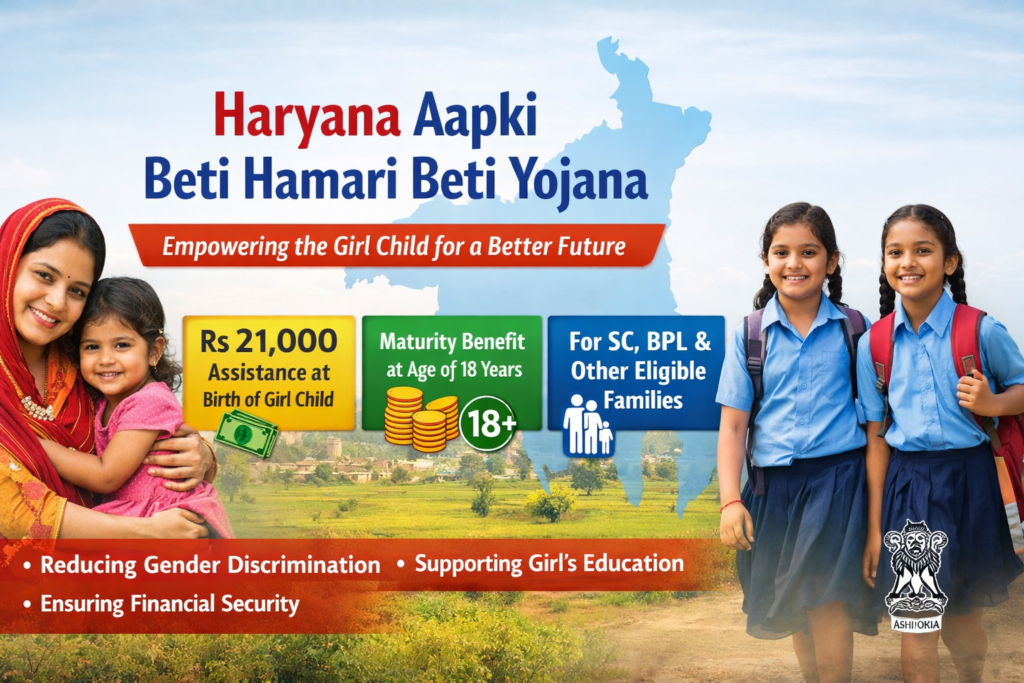
The Haryana Aapki Beti Hamari Beti Yojana is a social welfare initiative launched by the Government of Haryana to promote the value and well-being of the girl child. Introduced in 2015, the scheme aims to reduce gender discrimination, improve the declining child sex ratio, and encourage families to support the birth and education of daughters. Under this scheme, financial assistance of Rs 21,000 is provided at the birth of eligible girl children, which is invested and later given with interest when the girl turns 18 years old. It mainly benefits Scheduled Caste, BPL families, and also supports second and third girl children in other categories. By offering long-term financial security, the scheme motivates parents to ensure proper care, education, and a better future for their daughters.
The Haryana Aapki Beti Hamari Beti Yojana is a government welfare scheme launched in 2015 by the Women and Child Development Department, Haryana. The scheme focuses on promoting the birth and education of girl children while improving the gender ratio in the state.
Key Highlights
• Financial assistance of Rs 21,000 is provided at the birth of eligible girl child
• Amount is invested in LIC or similar financial institution
• Maturity amount is given after the girl turns 18 years
• Aimed at stopping female foeticide and promoting girl education
• Applicable to SC, BPL and other eligible families
Scheme Details
| Particular | Details |
|---|---|
| Scheme Name | Haryana Aapki Beti Hamari Beti Yojana |
| Launch Year | 2015 |
| State | Haryana |
| Department | Women and Child Development Department |
| Benefit Amount | Rs 21,000 |
| Application Mode | Online and Offline |
Benefits Provided
• Rs 21,000 investment for first girl child of SC and BPL families
• Rs 21,000 investment for second and third girl child of other categories
• Full amount with interest is given after completion of 18 years
• Financial support ensures better education and future security
Special Cases under Ladli Scheme
| Condition | Benefit |
|---|---|
| Second girl child born on or before 21 Jan 2015 | Rs 5,000 per year for 5 years |
| Twin or multiple girls born before 21 Jan 2015 | Rs 2,500 per girl per year |
| Eligibility Condition | No restriction on caste, religion, income |
Eligibility Criteria
• Applicant must be a permanent resident of Haryana
• First girl child in SC and BPL families
• Second and third girl child in other categories
• Mother must be registered at Anganwadi or Health Center
• Child must have proper vaccination records
• Aadhaar number required (parents Aadhaar acceptable initially)
• Child must be enrolled in Anganwadi as per age
Required Documents
• Birth Certificate of the girl child
• Family ID (Parivar Pehchan Patra)
• Caste Certificate (for SC category)
• BPL Card (if applicable)
• Residence Proof such as ration card, voter ID, electricity bill
• Vaccination card or immunization record
• Aadhaar card
Application Process
Online Method
• Visit Haryana Saral Portal
• Register using basic details
• Login using ID and password
• Fill complete application form
• Upload required documents
• Submit the application
• Application will be verified by authorities
• Approval notification will be provided
Offline Method
• Visit Women and Child Development office
• Collect application form
• Fill all required details carefully
• Attach necessary documents
• Submit the form at district office
• Application will be verified
• Eligible beneficiaries will be informed
Important Contact Details
| Service | Details |
|---|---|
| Saral Helpline | 0172-3968400 |
| Saral Email | saral.haryana@gov.in |
| WCD Helpline | 0172-2560349 |
| Women Helpline | 181 |
| WhatsApp Helpline | 9478913181 |
Office Address
Women and Child Development Department Haryana
Bays No 15-20 Sector 4
Panchkula Haryana 134112
Important Links (Reference)
• Haryana Saral Portal Registration – Click Here
• Scheme Login Page – Click Here
• Official Guidelines
• Application Form Download
Objective of the Scheme
• Improve gender ratio in Haryana
• Promote education of girl child
• Stop female foeticide
• Provide financial security to daughters
• Encourage positive social change